
Camp in remote high mountain landscapes and cross three spectacular Himalayan passes as you explore through one of the Annapurna region's most isolated mountain landscapes
The Kangaru Himal Trek is a remote and challenging camping trek in the Annapurna region, taking adventurous trekkers far beyond the busy trails of the Annapurna Circuit and into a rarely visited wilderness of high mountain passes, alpine grazing lands and spectacular Himalayan scenery. This off-the-beaten-path expedition follows ancient shepherd trails beneath the impressive Kangaru Himal massif, offering a genuine wilderness experience in one of Nepal’s least explored trekking areas.
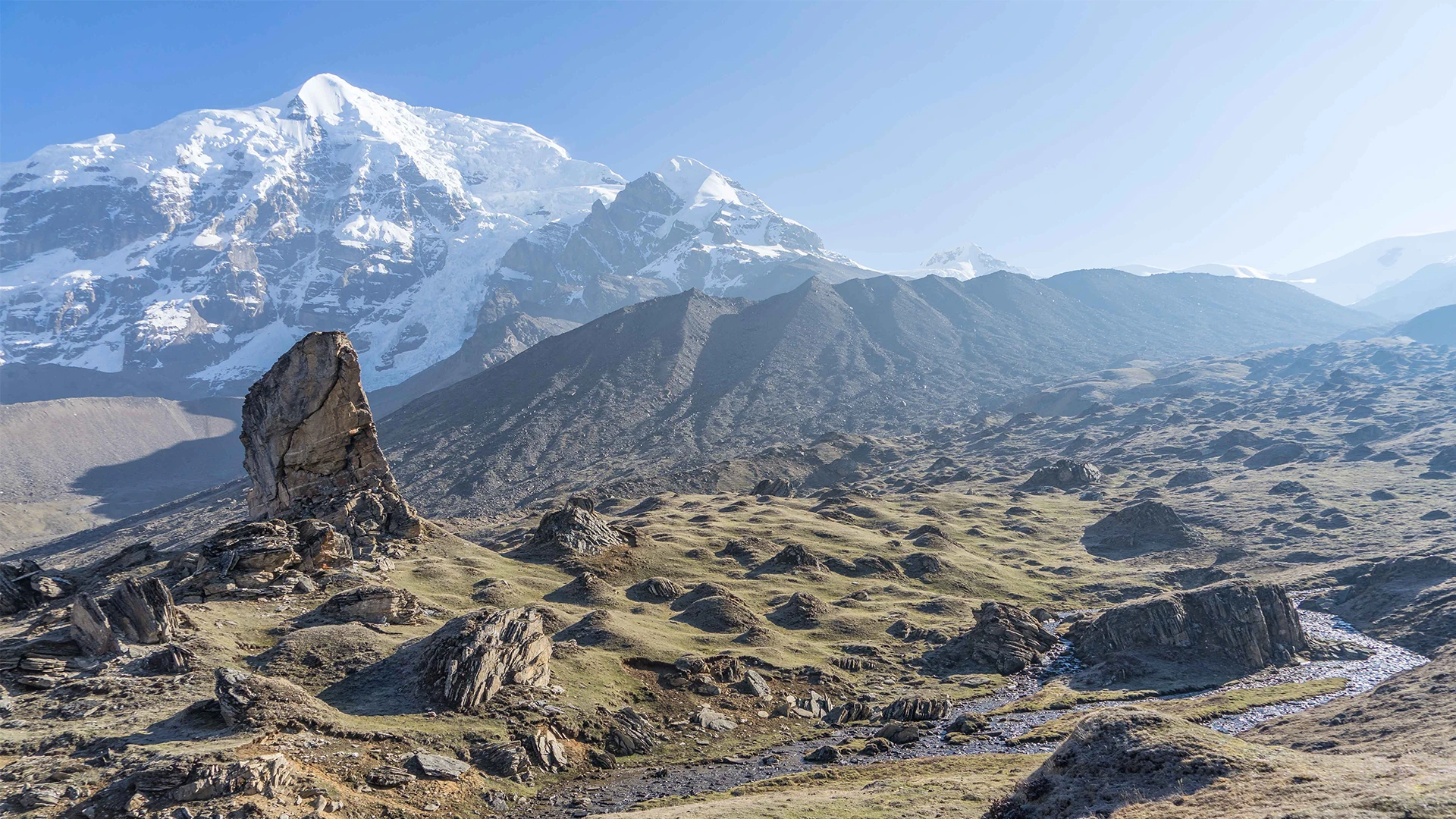
The journey begins through traditional Gurung villages and the beautiful Marshyangdi Valley before climbing steadily into remote pasturelands used seasonally by herders. As the trail gains altitude, dense forests give way to rugged alpine terrain, vast mountain amphitheatres and dramatic high-altitude landscapes surrounded by snow-capped peaks.
A major highlight of the trek is crossing three spectacular Himalayan passes: Kuchumro Pass (4,900m), Yarcha Pass (4,860m) and Meta Pass (4,635m). These remote crossings provide exceptional views of Annapurna II, Lamjung Himal, Kangaru Himal, Pisang Peak and the surrounding mountain ranges while offering a true sense of exploration and adventure.
Ideal for experienced trekkers seeking solitude, wilderness and a genuine expedition atmosphere, the Kangaru Himal Trek combines demanding mountain trekking, remote camping and outstanding Himalayan scenery far from Nepal’s more popular trekking routes.
Everything you need to know at a glance before your Kangaru Himal Trek.


Outline Itinerary
Day 1: Arrive in Nepal, transfer to hotel and submit passport for permits.
Day 2: Trek briefing and preparation in Kathmandu.
Day 3: Drive from Kathmandu to Tachai (2,340m), approx. 10 hours.
Day 4: Trek from Tachai to Shongle (3,360m), approx. 6-7 hours.
Day 5: Acclimatisation day in Shongle
Day 6: Trek from Shongle to Kuchumro Phedi (4,525m), approx. 5-6 hours.
Day 7: Trek from Kuchumro Phedi to Namge Phedi (4,500m) via Kuchumro Pass (4,900m), approx. 5 hours.
Day 8: Trek from Namge Phedi to Namakyu (4,445m) via Yarcha Pass (4,860m), approx. 4-5 hours.
Day 9: Trek from Namakyu to Meta (4,204m) via Meta Pass (4,635m), approx. 8 hours.
Day 10: Trek from Meta to Koto (2,600m), approx. 7-8 hours.
Day 11: Drive from Koto to Besisahar (760m), approx. 5-6 hours.
Day 12: Drive from Besisahar to Kathmandu, approx. 5-6 hours.
Day 13: Departure from Nepal.
Note: The itinerary is a guide only and may be subject to change at short notice due to weather, trail conditions or operational requirements.
Note: All tours are lead by a professional city tour guide
Detailed Itinerary
Day 1: Arrival in Nepal and Permit Preparation
Upon arrival at Tribhuvan International Airport, you will be met by a representative and transferred to your hotel in Kathmandu. Your passport will be collected to process the necessary trekking permits required for the expedition.
Overnight in Kathmandu.
Day 2: Trek Briefing and Preparation (B)
Today is reserved for trek preparations and a comprehensive briefing with your trek leader. Equipment checks, route discussions and final logistics will be completed before your departure into the Annapurna region.
Overnight in Kathmandu.
Day 3: Drive from Kathmandu to Tachai (2,340m) | Approx. 10 Hours (B L D)
An early departure takes you west from Kathmandu towards the Annapurna region. Following the Trishuli and Marshyangdi river valleys, the journey passes through rural towns, terraced hillsides and traditional villages. At Besisahar, you will transfer to a local four-wheel-drive vehicle for the rough mountain road to Tachai.
Along the route, enjoy views of waterfalls, steep valleys and traditional Gurung settlements as you gradually gain altitude. Tachai provides a peaceful introduction to the remote landscapes that lie ahead.
Overnight camping in Tachai.
Day 4: Trek from Tachai to Shongle (3,360m) | Approx. 6-7 Hours (B L D)
Your first trekking day begins with a sustained ascent to Chonga Danda (3,283m), a scenic ridge offering excellent views across the Marshyangdi Valley and surrounding mountains. After a short break, descend through beautiful forests before following the Chonga River upstream.
The trail passes through rhododendron and pine forests before reaching the remote campsite at Shongle, surrounded by pristine woodland and dramatic mountain scenery.
Overnight camping at Shongle.
Day 5: Acclimatization Day in Shongle (B L D)
Today is the day for acclimatization as it is essential for a safe and enjoyable trek. Spend time exploring the area and prepare for a challenging day ahead.
Day 6: Trek from Shongle to Kuchumro Phedi (4,525m) | Approx. 5-6 Hours (B L D)
Today involves a steady climb into increasingly alpine terrain. Passing seasonal shepherd shelters and grazing areas, the route gradually leaves the forest behind as expansive mountain views begin to open up.
As you approach Kuchumro Phedi, the landscape becomes rugged and windswept, providing a dramatic setting beneath the high pass that awaits tomorrow. The afternoon is spent resting and acclimatising before the first major pass crossing.
Overnight camping at Kuchumro Phedi.
Day 7: Trek from Kuchumro Phedi to Namge Phedi (4,500m) via Kuchumro Pass (4,900m) | Approx. 5 Hours (B L D)
A rewarding day begins with an early ascent towards Kuchumro Pass, the highest point of the trek at 4,900 metres. As you gain elevation, spectacular views unfold across the Annapurna range, Lamjung Himal, Manaslu and the surrounding high Himalayan landscape.
After spending time enjoying the views from the pass, descend gradually into the broad alpine basin of Namge Phedi. Surrounded by rugged ridges and open mountain terrain, this remote campsite offers an unforgettable wilderness experience.
Overnight camping at Namge Phedi.
Day 8: Trek from Namge Phedi to Namakyu (4,445m) via Yarcha Pass (4,860m) | Approx. 4-5 Hours (B L D)
Today’s route crosses the beautiful Yarcha Pass, traversing remote alpine slopes beneath the Kang Garu Himal massif. The ascent is gradual but continuous, leading to panoramic viewpoints overlooking remote valleys and mountain ridges.
From the pass, descend to Namakyu, a seasonal grazing settlement used by local herders during the summer months. The open grasslands and isolation of this area create a true sense of Himalayan wilderness.
Overnight camping at Namakyu.
Day 9: Trek from Namakyu to Meta (4,204m) via Meta Pass (4,635m) | Approx. 8 Hours (B L D)
One of the most scenic days of the trek begins with a gradual climb towards Meta Pass. Along the route, enjoy magnificent views of Annapurna II, Kang Garu Himal and Pisang Peak, while crossing remote glacial valleys and rugged alpine landscapes.
After reaching the pass, begin a long descent through high mountain terrain before arriving at Meta, a small settlement on the edge of the Nar Phu region. The village offers spectacular views of the surrounding peaks and serves as an important stop on routes leading deeper into the hidden valleys of Nar and Phu.
Overnight camping at Meta.
Day 10: Trek from Meta to Koto (2,600m) | Approx. 7-8 Hours (B L D)
Your final trekking day descends steadily from the high mountains into the greener landscapes of the Marshyangdi Valley. The trail passes through pine forests, river gorges, waterfalls and traditional settlements as you gradually leave the alpine environment behind.
Arriving in Koto marks the completion of your mountain adventure and provides a welcome opportunity to celebrate the successful crossing of three remote Himalayan passes.
Overnight in a teahouse.
Day 11: Drive from Koto to Besisahar (760m) | Approx. 5-6 Hours (B L D)
After breakfast, board a local jeep for the journey down the Marshyangdi Valley. The road follows dramatic river gorges and passes numerous traditional villages before reaching Besisahar, the gateway to the Annapurna region.
The remainder of the day is free to relax and reflect on the trek.
Overnight in Besisahar.
Day 12: Drive from Besisahar to Kathmandu | Approx. 5-6 Hours (B)
Today you return to Kathmandu along Nepal’s main highway network. The drive follows river valleys, terraced hillsides and rural settlements before arriving back in the capital.
The remainder of the day is free for sightseeing, shopping or relaxing after your expedition.
Overnight in Kathmandu.
Day 13: Departure from Nepal (B)
After breakfast, transfer to Tribhuvan International Airport for your onward flight.
Your Kang Garu Himal Trek comes to an end, taking with you memories of remote mountain passes, spectacular Himalayan landscapes and one of the Annapurna region’s most rewarding wilderness trekking experiences.
The itinerary is intended as a guide and may be subject to change at short notice due to weather, trail conditions, road conditions or operational requirements.
MEALS INCLUDED: B – breakfast | L – lunch | D – dinner
Note: All tours are lead by a professional city tour guide
Cost Includes
- Pre-trip advice and detailed information
- Expert trip leadership and motivated staff for the duration of the trek
- Airport transfers in Nepal (where applicable)
- 2 nights accommodation pre-trek & 1-night post-trek in Kathmandu
- 1-night accommodation pre or post-trek in Pokhara (where applicable)
- Transportation to and from trek start and finish for you and your trekking team (different budget options available)
- Basic teahouse/lodge/camping accommodation during the trek on a twin sharing basis
- During the trek all meals on a full board basis (breakfast, lunch, and dinner) to include tea/coffee during the meals, but excluding any drinks outside of the meal times
- All permits, conservation area, and restricted area fees
- Porters
- Insurance and equipment for Nepali staff
- Rescue assistance
- Group medical kit
Cost Excludes
- International flights to and from Kathmandu, Nepal
- Visa for Nepal
- Travel insurance (insurance to include evacuation is mandatory. Please make sure you are covered to the correct altitude)
- Personal expenses such as fizzy drinks, chocolate, gifts, snacks, hot showers during the trek, etc.
- Meals unless specified
- Sightseeing
- Gratuities
- Excess baggage on internal flights
- Charges incurred as a result of delays beyond the control of Himalayan Quests
What to Bring
Himalayan Quests uses a layering system where different pieces of clothing are worn together or separately to achieve optimum body temperature control. The upper body garments listed here are either synthetic or merino wool garments that retain their insulating properties when wet, or nylon or Gore-Tex layers which help prevent heat loss by cutting wind, rain, and snow.
This is a guideline only
| UPPER BODY LAYERS | ||
| Equipment | Quantity | Comments |
| T-Shirts – walking | 2 | We recommend merino wool, Capilene or other synthetic fabric as they wick away the moisture and dry quickly. No cotton. |
| T-shirt – sleeping | 1 | This can be cotton |
| Base layers (ie thermal top) | 1 | Lightweight or mid-weight long-sleeved t-shirt of merino wool, polyester, Capilene, or Polartec power dry |
| Top insulating Layers | 1 | Mid-weight fleece that can be worn over other layers |
| Fleece Vest | 1 | |
| Rain jacket | 1 | |
| Down Jacket | 1 | |
| LOWER BODY LAYERS | ||
| Equipment | Quantity | Comments |
| Underwear | Sufficient for the trek (remember you can wash them) | |
| Thermal long johns/long underwear | 1 | |
| Trekking Trousers | 2 | Lightweight quick-dry trousers (no cotton). Zip offs are good |
| Evening/sleeping trousers | 1 optional | 1 pair of lightweight tracksuit bottoms (sweat pants) or yoga style trousers for evening wear and sleeping in. No jeans. |
| Hiking Shorts | 1 | If no zip-off trousers. Below the knee for ladies |
| Rain Pants | 1 | |
| PACKS & BAGS | ||
| Equipment | Quantity | Comments |
| Day pack | 1 | Approx. 35ltrs. HQ will provide you with a duffle bag for your trekking gear |
| Sleeping bag with compression sack | 1 | Minimum 3 season |
| Sleeping bag liner | 1 | Optional |
FOOTWEAR
| Equipment | Quantity | Comments |
| Hiking boots | 1 | Must be well worn and comfortable with ankle support |
| Socks | 3 | |
| Sandals/Camp shoes | 1 | Lightweight for evening use |
| MISCELLANEOUS ITEMS | ||
| Equipment | Quantity | Comments |
| Water bottles | 2 | One liter each, Nalgene or Sig style or a bladder if preferred |
| Water purification drops | 1 | Cheap and easy to buy in Kathmandu (Piyus) |
| Lip Balm | 1 | With SPF factor |
| Sunscreen | 1 | We recommend SPF 30 or greater |
| Mosquito repellent | 1 | |
| Personal first aid kit | 1 | To include any prescribed medications |
| Sunglasses | 1 | |
| Bandana/Buff | 1 | Useful for a variety of purposes. |
| Flashlight /head torch | 1 | Head torch is best as it leaves your hands free + extra batteries |
| Travel towel | 1 | Lightweight and compact |
| Wash kit | Travel size items for the trek & eco friendly if possible | |
| Instant Hand Sanitizer | 1 | Alcohol-based for keeping hands clean |
| Sun hat | 1 | |
| Warm hat | 1 | |
| Gloves | 1 | |
| Trekking poles | Optional | |
| Trekking snacks | Good selection available in KTM | |
| Camera | With charger &/or extra batteries | |
| Toilet paper & rubbish bag | ||
| Book/journal | ||
| Pack of cards/travel game | 1 | For evening entertainment |
| Photocopies of all your important documents | ||
| Compression socks | 1 | Great for international flights & long road/jeep journeys |
| A great sense of humour & a positive attitude | Essential – don’t come without it!! | |
Similar Trips


Trip Photo Stories


FAQs for Kangaru Himal Trek
What will the food be like?
There are is a set menu that is used by all of the tea houses along the trek, with such foods as: Breakfast – porridge, eggs, Tibetan bread, rice pudding. Lunch/Dinner – dal bhat, pasta, soup, mo mos, eggs, chapati, noodles. Tea and coffee will be served at each meal.
What will the weather be like?
Generally, the weather is warm/hot during the day with the temperatures dipping at night into the early morning. The higher you go, the cooler the temperatures get. During the spring season the minimum night time temperature at Badal Dada / High Camp should be just below freezing, although it will depend on the weather at the time. During the autumn season, traditionally the minimum night time temperature will be below freezing, possibly as low as -5 to -10 degrees Celsius up high. The mountains have their own micro climates, and climate change is impacting the traditional weather patterns and you need to be prepared for all conditions – sun, rain, snow, ice.
Do I need travel insurance for trekking in Nepal?
Yes. We strongly recommend comprehensive travel insurance that covers trekking at the maximum altitude of your chosen route, as well as emergency medical treatment and evacuation where appropriate.
What happens if I get sick or there is an emergency during the trek?
Our guides are trained to respond to common trekking emergencies and will coordinate assistance when necessary. Depending on the location and situation, this may involve rest and observation, descent, evacuation or medical support.
How do I deal with altitude sickness?
Altitude sickness can affect anyone, regardless of age or fitness. Our itineraries are designed with acclimatisation in mind, and our guides monitor trekkers throughout the journey. Staying hydrated, walking at a steady pace and allowing your body time to acclimatise are important.
Will I be carrying my own gear on the trek? How much luggage can I take on a trek?
You will be provided with a duffle bag for your main trekking gear, which will be carried by a porter. The weight limit per person for this is 10kg. You will just carry your day pack with your personal items for the day.
Is there electricity / WiFi on the trek?
There is only mains electricity at the teahouses on the first and last night, the rest are all solar powered. You are able to charge your phones, camera batteries, however, the teahouse may make a small charge, especially where there is no mains power. Some trekking areas have mobile connectivity and Wi-Fi at certain villages, while remote sections may have little or no connectivity. We recommend being prepared for periods without a reliable signal.
What is the accommodation like on the trek? Do I need to bring a sleeping bag?
You will be sleeping in small, simple teahouses along the trek. The rooms are usually twin or triple. Single rooms cannot be guaranteed. Attached bathrooms might only be available on the first and last nights of the trek. Simple beds with a sheet and pillow are provided. A sleeping bag and liner will be provided for you during the trek.
What clothing/gear do I need to bring for the trek?
Please refer to the detailed gear list you have been provided with. Ladies, please make sure any trousers or shorts fall below the knee. Please make sure your walking boots are well worn in and comfortable. Technical gear such as ropes and crampons are not required for this trek, although micro spikes/Yak Trax will be useful if the conditions are snowy/icy up at high camp. These can be bought cheaply (c.£10 a pair) in Nepal.
Do I need previous trekking experience?
Not necessarily. You don’t need previous trekking experience, but a good level of physical fitness, proper preparation, and the ability to walk for several hours a day are important.
What is the best time of year to trek in Nepal?
The main trekking seasons are spring (March-May) and autumn (September-November), when conditions are generally favourable. There are also some lower-altitude and rain-shadow treks that can be suitable during the monsoon, while winter offers clear skies but colder conditions at higher elevations.








 9 Days
 Everest Region
 Easy/Moderate